
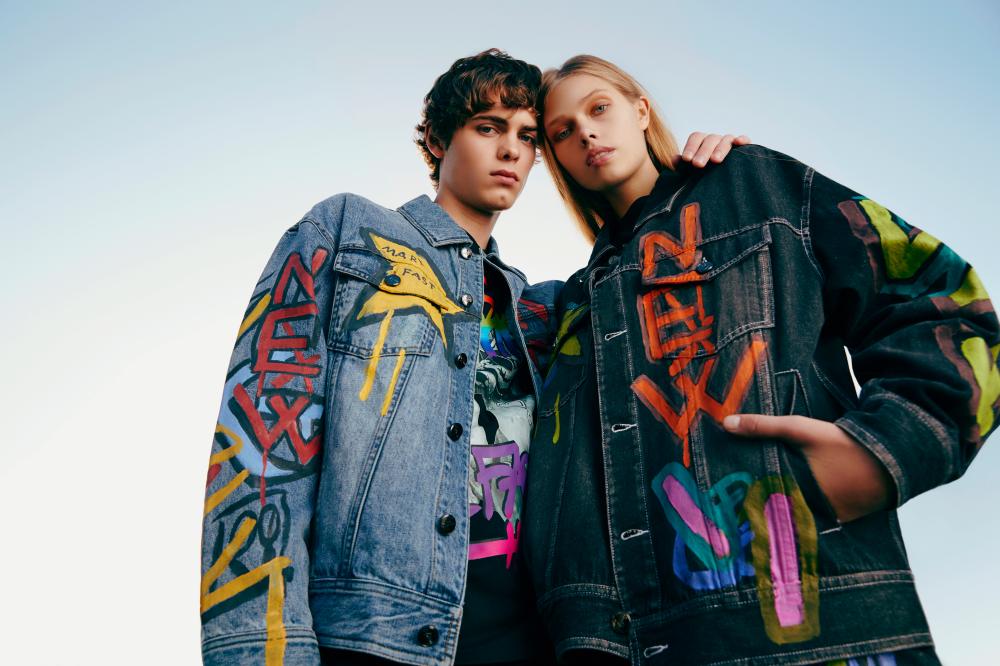
MARK FAST Tops: What Makes a Shirt More Than Just a Shirt
Most people know MARK FAST for its knitwear. But the brand’s tops — including shirts, T-shirts, and printed tops — carry the same design principles: tension, color logic, and body awareness.
This isn’t a product catalog. We want to show how MARK FAST approaches a simple top differently from other brands.

Who Is Mark Fast? A Designer Who Doesn’t Follow Rules
Mark Fast was born in Winnipeg, Canada, and graduated from Central Saint Martins in London. In 2008, he showed his first collection at London Fashion Week, was selected for the British Fashion Council’s NEW GEN scheme, and has been a regular on the LFW schedule ever since.
He started with a home knitting machine, but his approach to tops goes beyond knitwear. In his view, any top — whether a shirt or a T-shirt — should do three things: follow the body’s lines, use colors that make sense, and have prints that come from a real creative process.
Mark Fast once said in an interview: “I don’t want to make clothes that look good on a hanger but fall apart on a body.” That statement became the basic rule for how MARK FAST designs tops.
Three Core Principles of MARK FAST Tops
Pick up any MARK FAST shirt or T-shirt, and you’ll see three consistent features:
Prints come from hand drawings, not stock libraries
MARK FAST prints aren’t taken from existing stock libraries. Mark Fast has an art background. Most of the brand’s prints start as his hand sketches, collages, or elements from his art projects. Each season’s print theme is different, but it always traces back to a specific handmade process.
Colors have a clear source
The colors on MARK FAST tops aren’t random. Mark Fast’s usual method is to take a set of colors from urban landscapes, industrial waste, or a specific modern art piece, then build an entire season around that palette. That’s why the brand’s color combinations often feel unexpected but still work.
Fit serves the body
MARK FAST never uses “one size fits all” or “loose equals comfortable” as an excuse. Even on relaxed-fit tops, the shoulder line, neckline, and armhole are calculated. The goal is to keep a clear silhouette even when the fabric is relaxed. Mark Fast has said openly that he dislikes designs where “the clothes wear the person.” He insists that the wearer’s body should be the main character.
A Real Event: The 2010 Casting Decision
Before London Fashion Week in 2010, there was a disagreement inside the MARK FAST team. The stylist and some team members suggested Mark Fast use only very thin models, saying it was “industry standard.” Mark Fast refused. He insisted on using UK size 12–14 models and replaced the team members who disagreed.
The story was covered by The Daily Telegraph and Vogue. Mark Fast later explained: “My tops are made for real women’s bodies. If a top only looks good on a small sample size, it’s not a good top.”
From 2010 until today, every MARK FAST lookbook and runway show has maintained body diversity. This wasn’t a one-time PR move. It’s been a standard for over a decade.

How to Tell If a Top Fits You Well — From MARK FAST’s Perspective
Mark Fast doesn’t teach people “how to look skinny.” But he has shared a practical method for checking if a top fits well. You can use it too.
Step 1: Check the shoulder seam
The shoulder seam should land exactly on the bony edge of your shoulder. Too far inward feels tight. Too far outward looks sloppy.
Step 2: Check the neckline
The neckline shape decides where your visual focus goes. MARK FAST tops offer crewneck, V-neck, square neck, and other options for different neck lengths and face shapes.
Step 3: Check the sleeve length
Where the sleeve ends changes how your arm looks. For a cleaner line, choose sleeves that end above your wrist bone. For a relaxed look, choose sleeves that cover half your wrist.
Step 4: Check the print density
Large, dense prints have strong presence — good for when you want to be noticed. Smaller, spaced-out prints are more everyday. MARK FAST makes both. The difference is what signal you want to send.

Four Common Misconceptions About MARK FAST Tops
Misconception 1: Printed tops are hard to style
Most MARK FAST prints have a dominant color. If you pull one color from the print and use it for your bottoms or accessories, it works. The brand designs with that flexibility in mind.
Misconception 2: Relaxed T-shirts mean sloppy
MARK FAST relaxed tops have precisely curved armholes and necklines. They look casual, but your neck and shoulder lines stay clear. Relaxed is not the same as shapeless.
Misconception 3: Colorful tops are only for young people
MARK FAST customers range widely in age. The real factor isn’t age — it’s willingness to wear color. Mark Fast has said: “Color has nothing to do with age. It has to do with courage.”
Misconception 4: Designer tops aren’t for everyday wear
MARK FAST keeps runway pieces and daily-wear pieces as two separate lines. The daily line uses more practical fabrics and fits, while keeping the brand’s color and print language.
Who Is MARK FAST For?
In one sentence: For people who don’t want their clothes to define them.
A MARK FAST top won’t hide your body or force it into a different shape. It fits you, follows you, and shows what’s already there. Mark Fast’s design philosophy is “to be seen,” not “to be wrapped.”
If you’re tired of brands that make you feel like your body is wrong, or if you want a top that does more than just cover you — that actually says something — then MARK FAST is worth your time.

Summary
MARK FAST isn’t a brand that survives on viral hits. Since 2008, it has stayed on the London Fashion Week calendar with a consistent set of principles: hand-drawn prints, logical colors, body-friendly fits.
This article didn’t recommend any specific product. What we wanted to say is this: a good top should make you feel more like yourself after you put it on, not more like someone else.