
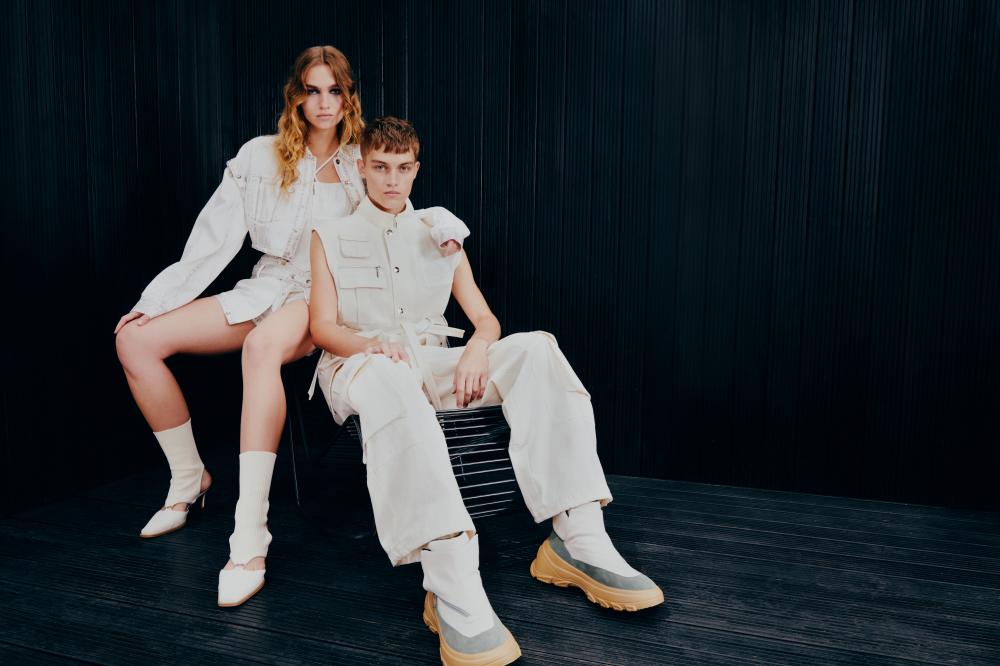
Why Do Older Clothes Become More Captivating? | The Aesthetic Philosophy of MARK FAST
Meta Description:
In a world dominated by "fast fashion," MARK FAST chooses a different path: letting clothes grow more valuable through the traces of life. This is not a product pitch, but an exploration of dressing, memory, and the aesthetics of time.
We live in an age that celebrates "newness."
New items every week, clearance sales every month, a change of style every season. Clothing has gone from lasting a season to lasting two weeks, and from two weeks to "just enough for one photoshoot."
But outside this rhythm, there is a completely different voice saying:
What's truly worth wearing are the things that grow old with you.
This is not nostalgia, nor is it reducing consumption. It is a way of life called "slow aesthetics." And MARK FAST is the authentic echo of this philosophy in the modern wardrobe.

How much story can one piece of clothing hold?
Do you have a shirt whose cuffs have been rolled up countless times, whose collar holds the crease of you reading with your head down?
A jacket whose left pocket is slightly worn from always holding your keys?
A pair of trousers whose knees have gradually formed a curve that belongs only to you?
These marks are not "age." They are time's signature.
The starting point of MARK FAST's aesthetic is right here.
We don't pursue "perfect as new." We pursue "becoming more like you the more you wear it." This philosophy of dressing is known in the East as "nurturing," and in the West as "wear in, not wear out" — not wearing things out, but wearing life into them.

An authentic brand comes from authentic craftsmanship.
In the early development of MARK FAST, we collaborated with a master craftsman.
He was neither a designer nor an influencer. In a tiny workshop with just over a dozen people, he used an old-style shuttle loom, decades old, producing only a few dozen meters of fabric a day.
MARK FAST chose him, not the faster, cheaper modern looms.
Because we believe: only fabric that is slow, that has tension, that breathes, can truly record the life of the person who wears it.
That old weaver once said something that still hangs on the whiteboard in our studio:
"Fabric is not dead. It remembers how you wear it."
This is not poetic rhetoric. Fabrics woven with coarse yarns and low tension do indeed change their texture gradually with your body heat, your movements, and how you wash them. Just like leather, like wood, like the way you walk — the clothes get to know you.
"Imperfection" is the highest form of beauty.
We are often asked: Why do MARK FAST clothes look a little "unfinished" when new?
The answer is simple: we give back to the wearer the right to complete the work.
Industrial clothing pursues "peak perfection at the factory" — three-dimensional cutting, pre-washed distressing, artificial textures. But we believe that true individuality is not bought; it is lived.
A MARK FAST jacket might feel a bit stiff for the first three months, the color very dark, the lines very straight.
Six months later, a halo-like fade appears at the elbows, the cuffs soften, the hem curls slightly.
A year later, it becomes a piece that only you can wear.
This is not mysticism; it's physics.
The breaking and reshaping of cotton fibers, the peeling away of indigo dye layer by layer, the natural deformation of fabric under tension — these are the most honest diary entries of a garment.

Why do we need this kind of "slow"?
On one visit, we met an elderly tailor who had spent his life repairing work jackets and everyday coats.
He showed the MARK FAST team a vintage work jacket that had been passed down through three generations. It had accompanied a grandfather driving trucks, a father fixing motorcycles, and now a grandchild teaching at a university.
That old tailor said something we will never forget:
"This garment has never died. It's just changed owners."
In that moment, we realized: true sustainability is not shredding clothes for recycling — it's having them loved long enough.
MARK FAST doesn't do "green marketing" or shout slogans. We simply believe:
A single piece you're willing to wear for ten years is worth more than a hundred pieces you wear only once for a photo.

Conclusion: Your wardrobe should be a diary.
So, we wrote this article not to sell you anything.
If you already have that jacket in your closet that has walked many roads with you, those trousers with faded knees — then you are already living the MARK FAST aesthetic.
If you don't yet, next time you choose an item, ask yourself one question:
"How long is this willing to stay with me?"
When the answer shifts from "one season" to "many years," you will understand our language.